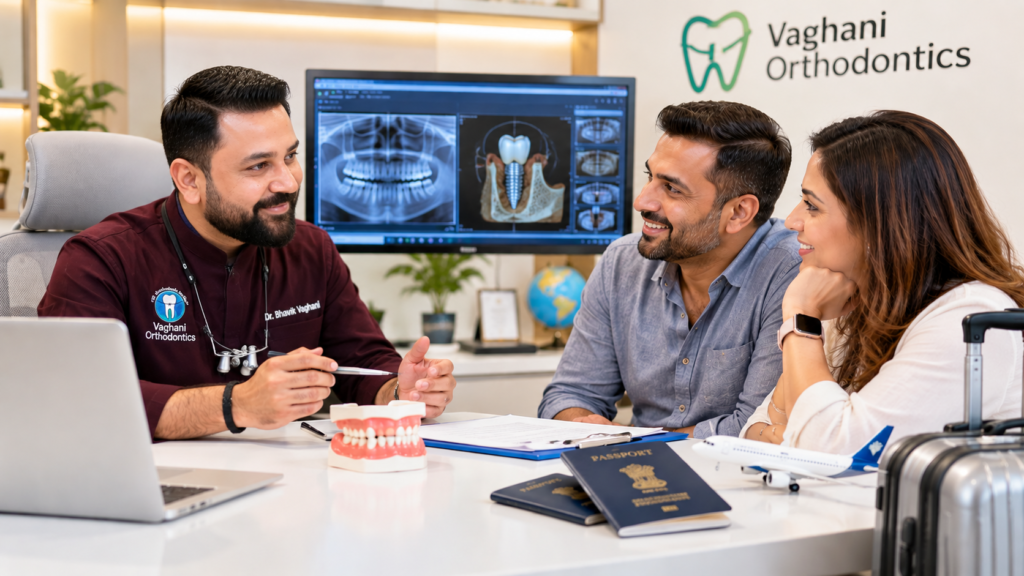
If you are an NRI planning a visit to India, your trip may also be an opportunity to take care of dental treatment that you have been postponing abroad.
But there is an important difference between simply booking a dental appointment after arriving in India and planning your dental treatment before you travel.
Complex treatments such as dental implants, full-mouth rehabilitation, smile designing, veneers and clear aligners may require investigations, treatment planning, multiple appointments and follow-up. For NRI patients with a limited stay in India, planning becomes especially important.
This guide explains how you can prepare for dental treatment before travelling to India, what information your dentist may need, and how treatment can be coordinated around your available time.
Why Do NRIs Consider Dental Treatment During Their India Visit?
Many NRIs visit India periodically to meet family, attend weddings or functions, take holidays, or manage personal commitments.
For some patients, this creates an opportunity to combine their India visit with planned dental care.
Depending on the patient’s dental condition and treatment requirements, this may include:
- Dental implants
- Full-mouth rehabilitation
- Crowns and bridges
- Smile designing
- Dental veneers
- Clear aligner treatment
- Orthodontic consultation
- Root canal treatment
- Teeth whitening and other aesthetic dental procedures
However, the treatment that can realistically be completed during one visit varies considerably from patient to patient.
That is why the first question should not simply be, “How quickly can my treatment be completed?”
A better question is:
“What can be safely and predictably planned during the time I will be in India?”
Start Planning Before You Fly to India
One of the most useful things an NRI patient can do is contact the dental clinic before booking treatment dates.
An initial online discussion allows the dental team to understand:
- Your main dental concern
- Previous dental treatment
- Your available travel dates
- Relevant medical history
- Existing X-rays or scans
- Photographs of your teeth and smile
- Your expectations from treatment
For some treatments, these records may allow the dentist to provide an initial understanding of possible treatment options.
However, an online consultation does not replace a complete clinical examination. The final diagnosis and treatment plan may change after an in-person examination and any necessary investigations.
What Dental Records Should You Send Before Travelling?
If you already have recent dental records from your dentist abroad, keep them available.
Depending on your condition, useful records may include:
- Recent dental X-rays
- OPG/panoramic X-ray
- CBCT scan, when relevant
- Previous treatment reports
- Implant details, if you already have implants
- Details of existing crowns, bridges or dentures
- Clear photographs of your teeth and smile
- Relevant medical history and current medications
Not every patient requires every record.
Your dentist can advise which investigations are actually necessary for your particular treatment.
Dental Implants for NRI Patients
Dental implant treatment requires careful diagnosis and planning.
The dentist may need to evaluate factors such as the amount and quality of available bone, gum health, the position of nearby anatomical structures, your bite, the number of missing teeth, general health factors and the type of final restoration required.
Some implant cases may involve additional procedures such as bone grafting or other preparatory treatment.
This is particularly important for NRI patients because implant treatment does not always mean one appointment and a finished tooth.
Depending on the case, treatment may involve different phases, with healing time between implant placement and the final prosthetic restoration.
Therefore, if you are considering implants during your India visit, share your expected arrival and departure dates with your dentist as early as possible.
Full-Mouth Rehabilitation Requires Even More Planning
Patients with multiple missing, damaged or heavily restored teeth may require a comprehensive treatment plan rather than treatment of individual teeth in isolation.
Full-mouth rehabilitation can involve combinations of:
- Dental implants
- Crowns and bridges
- Restorative dentistry
- Gum treatment
- Root canal treatment
- Bite correction
- Prosthetic rehabilitation
These cases can be complex.
For an NRI patient, the dental team should consider both the clinical requirements and the patient’s available time in India.
Trying to fit an inappropriate amount of treatment into a short trip simply because a return flight has already been booked is not ideal.
Treatment planning should come first; the travel schedule should then be coordinated around what is clinically appropriate whenever possible.
Smile Designing and Veneers During an India Visit
If your concern is primarily aesthetic, a smile assessment should involve more than simply choosing a lighter tooth shade.
Smile designing may consider factors such as:
- Tooth shape and proportion
- Tooth position
- Smile line
- Gum display
- Tooth colour
- Facial proportions
- Lip position
- Existing restorations
- Bite and functional requirements
Depending on the individual case, treatment could involve whitening, composite bonding, orthodontics, veneers, crowns, gum contouring or a combination of procedures.
Not every smile makeover requires veneers, and veneers are not appropriate for every patient.
A proper assessment should determine the most conservative and suitable approach for your particular smile.
Can NRIs Start Clear Aligners in India and Continue Treatment Abroad?
This is an especially important question for patients who live outside India.
Clear aligner treatment takes place over months rather than during a short holiday, so the plan needs to account for what happens after you return abroad.
Before beginning treatment, discuss:
- How your orthodontic assessment will be completed
- How the treatment will be digitally planned
- How aligner sets will be provided
- When in-person reviews may be required
- How progress will be monitored remotely
- What to do if an aligner is lost or does not fit
- Whether attachments or other procedures will be needed during treatment
- How retainers and post-treatment follow-up will be managed
Remote communication can make follow-up more convenient in suitable cases, but it does not eliminate the need for appropriate professional supervision or in-person care when clinically necessary.
How Long Should You Stay in India for Dental Treatment?
There is no single duration that applies to every patient.
The required time depends on:
- The diagnosis
- Type and complexity of treatment
- Number of teeth involved
- Healing requirements
- Laboratory stages
- Whether surgery is required
- Whether additional procedures are needed
- Your response to treatment
For this reason, be cautious about choosing treatment solely because someone promises it can be completed within a particular number of days.
Instead, tell your dentist exactly how long you will be in India and ask which stages can appropriately be completed during that period.
Questions to Ask Your Dental Clinic Before Booking Your Trip
Before travelling, consider asking:
- Can my case be initially assessed online?
- Which X-rays, scans or photographs should I send?
- What treatment options may be appropriate for my condition?
- How many in-person appointments could be required?
- What is the expected treatment sequence?
- Will I require a second visit to India?
- What happens if the treatment plan changes after clinical examination?
- How will follow-up be managed after I return abroad?
- Who will perform the different stages of my treatment?
- What records will I receive after treatment?
These questions can help you understand the process before committing your travel time.
Choosing a Dental Clinic in India as an NRI
Price is naturally one consideration, but it should not be the only factor when choosing where to undergo treatment.
Look at the qualifications and experience of the treating clinicians, diagnostic process, treatment planning, sterilization protocols, technology used where relevant, quality of communication, documentation, follow-up arrangements and how the clinic manages complications or unexpected findings.
For specialist procedures, it is also reasonable to ask who will actually be planning and performing your treatment.
A well-planned treatment is more important than simply choosing the fastest or least expensive option.
Planning Dental Treatment in Surat
For NRIs whose family or travel plans bring them to Surat, arranging the initial dental discussion before arrival can help make better use of the available time.
At Vaghani Orthodontics in Surat, NRI and international patients can contact the clinic before travelling to discuss their dental concerns, available records and expected dates in India.
Where appropriate, an initial online consultation can help determine what additional records may be required and what treatment possibilities can be discussed before an in-person examination.
The definitive treatment plan is established after the necessary clinical examination and investigations.
Plan Your Dental Visit Before You Fly
If you are living abroad and planning to visit India, you do not necessarily need to wait until you land in Surat to begin the conversation about your dental treatment.
Preparing in advance can help both you and your dental team understand your priorities, available treatment time and follow-up requirements.
Planning a Visit to Surat?
If you are considering dental implants, smile designing, veneers, clear aligners or comprehensive dental treatment during your India visit, you can contact Vaghani Orthodontics before you travel.
Share your dental concern, available X-rays or photographs, country of residence and expected travel dates with our team to begin your preliminary assessment.
Book an Online Consultation / Plan My Dental Visit